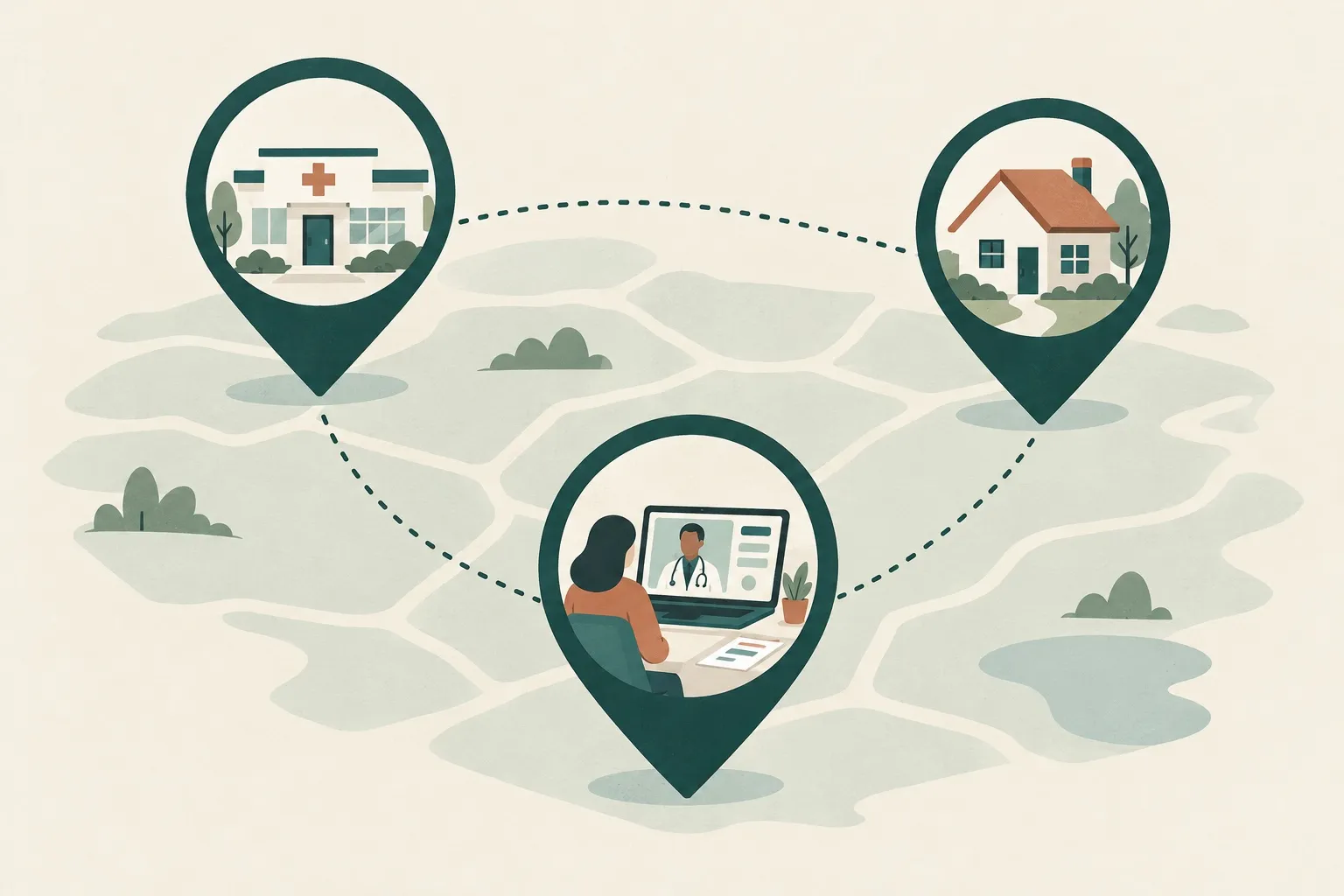
Place of service (POS) codes are two-digit codes that tell an insurer where a service was provided. For outpatient clinicians, the three you will use most are POS 11 (office, in person), POS 10 (telehealth with the patient at home) and POS 02 (telehealth with the patient somewhere other than home). Each service line on a claim or superbill carries one POS code.
This guide lists the POS codes most relevant to outpatient and private practice providers, explains how to choose between POS 02 and POS 10, shows how POS appears on a superbill, and covers why you need to check each payer’s rules.
What are place of service codes?
CMS maintains the national list of place of service codes. They are used on professional claims, including the CMS-1500 paper form (Box 24B) and its electronic equivalent, to identify the setting where care was delivered. Commercial payers, Medicaid and Medicare all use the same code set, though their billing rules for a given code can differ.
POS matters for two reasons:
- Coverage. Some services are only covered in certain settings, and telehealth coverage depends heavily on the POS and modifier combination.
- Payment. Some fee schedules pay differently for facility and non-facility settings, so POS can affect the allowed amount.
Common POS codes for outpatient providers
The table below uses the official CMS names, with a plain-words explanation.
| POS | Official CMS name | What it means in plain words |
|---|---|---|
| 02 | Telehealth Provided Other than in Patient’s Home | Telehealth visit where the patient is not at home (for example at work, school or another facility) |
| 10 | Telehealth Provided in Patient’s Home | Telehealth visit where the patient is in their own home |
| 11 | Office | In-person visit at your practice location (not part of a hospital) |
| 12 | Home | In-person visit at the patient’s private residence |
| 19 | Off Campus-Outpatient Hospital | Outpatient department of a hospital located away from the main hospital campus |
| 22 | On Campus-Outpatient Hospital | Outpatient department on the hospital’s main campus |
| 49 | Independent Clinic | A clinic that is not part of a hospital and only sees outpatients, not described by another POS code |
| 53 | Community Mental Health Center | A facility that provides community mental health services such as outpatient care, day treatment and screening |
| 99 | Other Place of Service | A setting not described by any other POS code |
Most private practice therapists, dietitians, speech-language pathologists and similar providers only ever use 02, 10 and 11, with 12 for home visits. Codes 19 and 22 apply when you work in a hospital outpatient department. POS 99 is a catch-all and should be rare; payers may question it.
What is POS 10?
POS 10 is the telehealth code for visits where the patient is located in their home during the service. CMS describes home here as a private residence, not a hospital or other facility. POS 10 was added in 2022, and at the same time POS 02 was redefined to mean telehealth when the patient is not at home.
Typical POS 10 situations:
- A therapy client joins a video session from their living room
- A nutrition counseling client calls in from home for an audio-only follow-up, where the payer covers audio-only
- A parent and child join a speech therapy session from home
What is POS 02?
POS 02 is the telehealth code for visits where the patient is somewhere other than their home. Examples:
- A client joins a video session from a private room at work
- A student joins from a school counseling office
- A patient joins from another clinic or facility that hosts the connection
Before 2022, POS 02 covered all telehealth. If you are using an old superbill template that lists POS 02 for every remote session, update it.
POS 02 vs POS 10: how do you decide?
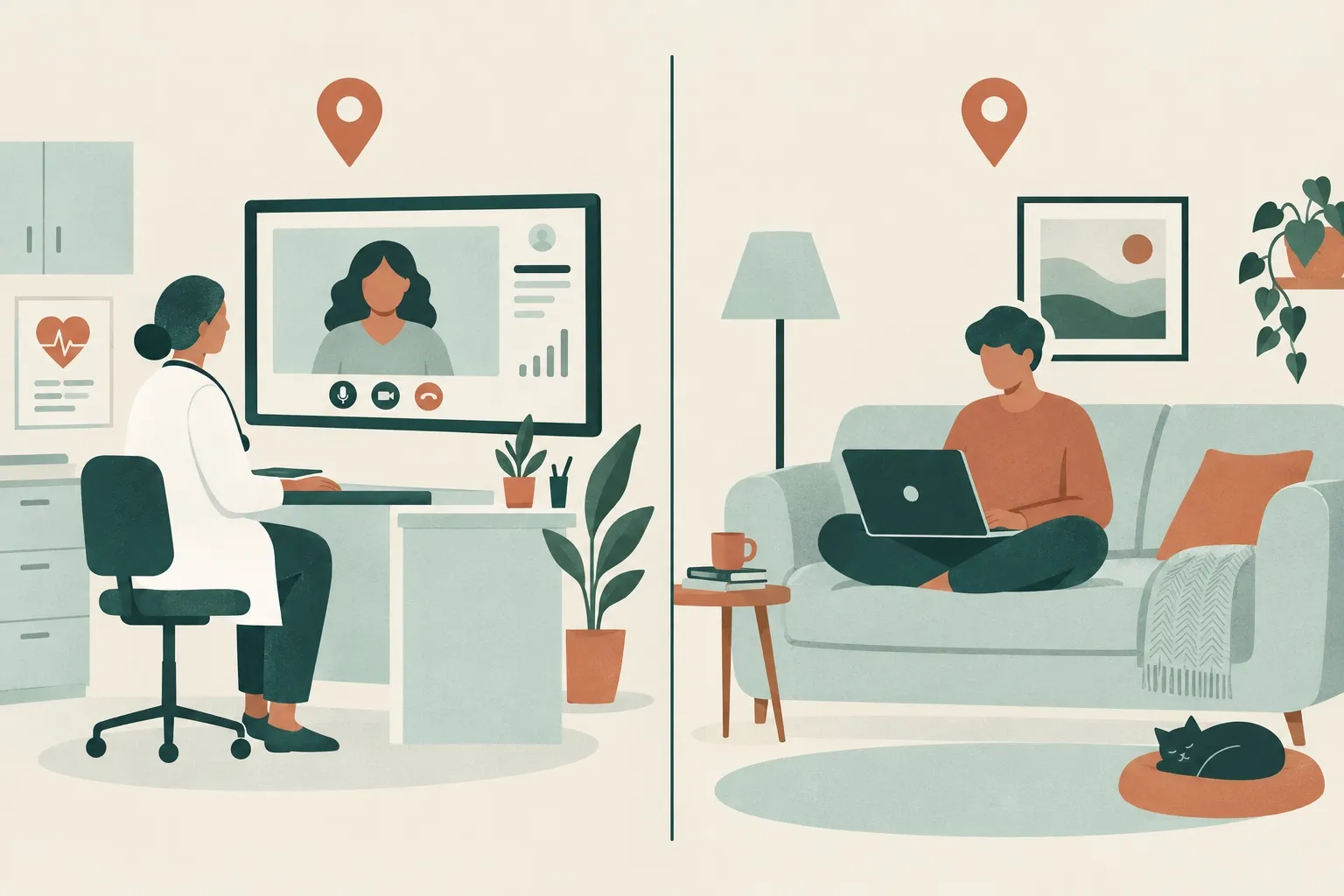
Ask one question: where was the patient during the visit? The clinician’s location does not determine the telehealth POS.
| Patient’s location during the visit | Clinician’s location | Typical POS |
|---|---|---|
| Patient’s home | Clinician’s office | 10 |
| Patient’s home | Clinician’s home | 10 |
| Patient’s workplace | Clinician’s office | 02 |
| Patient’s school | Clinician’s office | 02 |
| In the clinician’s office, in person | Clinician’s office | 11 |
| Patient’s home, clinician visits in person | Patient’s home | 12 |
Document the patient’s location in every telehealth note. If a payer questions the POS, the note is your evidence.
Is POS 11 ever used for telehealth?
Sometimes. During and after the COVID-19 public health emergency, some payers, including Medicare for a period, told providers to bill telehealth with the POS that would have applied in person (often 11) plus modifier 95. Some commercial payers still prefer that approach, while others require POS 02 or 10.
Because these instructions have changed several times and differ by plan, the safest approach is:
- Look up each payer’s current telehealth billing policy (usually in the provider manual or a telehealth policy bulletin).
- Note which POS and modifier combination that payer wants.
- Apply it consistently, and recheck at least once a year.
How do telehealth modifiers work with POS?
Telehealth claims often need a modifier on the CPT code in addition to the POS:
- 95: synchronous telemedicine using real-time audio and video. Widely used by commercial payers.
- GT: an older audio-video telehealth modifier that some payers still request.
- 93: used by some payers for services delivered by audio only.
Some payers require a modifier with POS 02 or 10, some say the POS alone is enough, and some require POS 11 plus modifier 95. Medicare and commercial rules on modifiers 95, GT and 93 have shifted over time. Always check current payer and CMS guidance rather than relying on what worked last year.
How does the place of service code appear on a superbill?
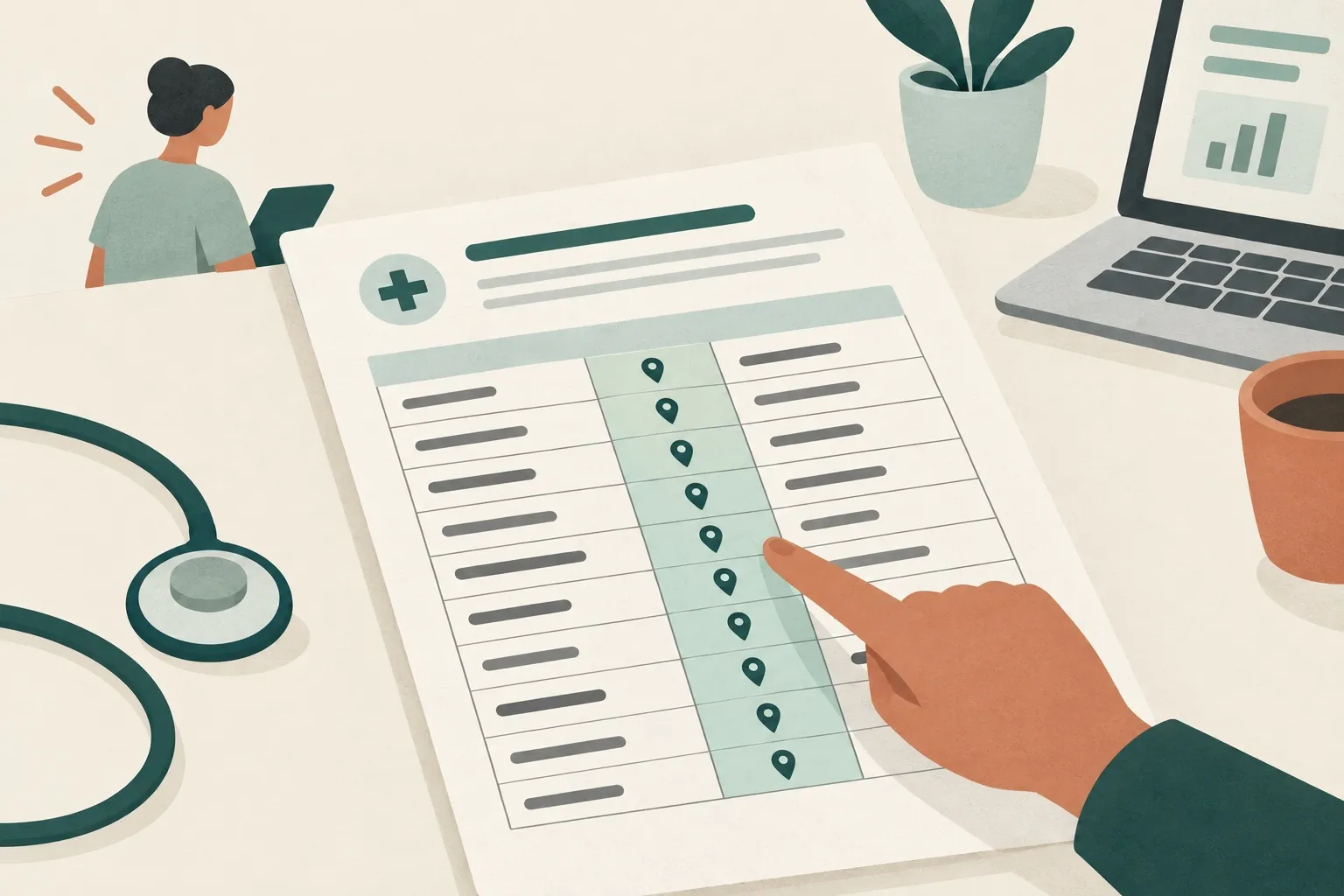
A superbill lists each session as a service line, and each line has its own POS. That matters when a client has a mix of in-person and telehealth visits in the same month. Example (fictional data):
| Date | CPT | Mod | POS | Dx pointer | Units | Fee |
|---|---|---|---|---|---|---|
| 10/02/2026 | 90834 | 11 | A | 1 | Your full fee | |
| 10/09/2026 | 90834 | 95 | 10 | A | 1 | Your full fee |
| 10/16/2026 | 90834 | 95 | 02 | A | 1 | Your full fee |
Line 1 was in the office. Line 2 was video with the client at home. Line 3 was video with the client at their workplace. The CPT code is the same each time; only the POS and modifier change. For more on the code itself, see our CPT code 90834 guide.
When an insurer processes a superbill, staff typically key its data into the same fields used on a CMS-1500, so the POS on your superbill ends up in Box 24B. Our comparison of a superbill vs the CMS-1500 shows how each superbill field maps to the claim form.
POS is also on the list of what to include on a superbill. A missing POS is one of the easiest ways to get a superbill returned unprocessed.
Which POS code should you use? Quick examples by profession
The rules are the same across professions, but it helps to see them in context. These assume the payer follows the POS 02/10 approach; adjust if a payer tells you otherwise.
- Therapists and psychologists: in-office sessions are POS 11. Video sessions with the client at home are POS 10. A client who joins from a private office at work is POS 02.
- Speech-language pathologists: teletherapy with a child at home is POS 10. A session delivered by video to a student at school is POS 02. Some school-based arrangements have their own billing rules, so check with the payer.
- Dietitians: in-person nutrition counseling at your practice is POS 11; virtual follow-ups with the client at home are POS 10.
- Physical and occupational therapists: clinic visits are POS 11, and in-person visits at the patient’s home are POS 12, not POS 10. POS 10 is only for telehealth.
- Chiropractors and acupuncturists: hands-on care is almost always in person, so POS 11 is the norm.
Where can you find the official POS list?
CMS publishes the full Place of Service Code Set on its website, with the official name and definition of every code. It is updated from time to time, so check the current list if you run into an unusual setting, or if a payer rejects a code you have used for years.
Common POS mistakes
- Using POS 02 for every telehealth visit after POS 10 was introduced.
- Using the clinician’s location instead of the patient’s to choose the POS.
- Leaving POS blank on a superbill.
- Mixing payer rules, such as using one plan’s POS 11 plus 95 approach on another plan that requires POS 10.
- Using POS 99 when a specific code applies.
- Not documenting the patient’s location in the telehealth note.
Add the right POS to every service line
The free superbill generator includes a POS field on every service line, so you can mix office and telehealth sessions on one superbill and get each one right. It runs entirely in your browser, and nothing is uploaded. Mental health providers can start from the therapist superbill template, and nutrition professionals can use the dietitian superbill template.
FAQ
What is POS 10?
POS 10 is the place of service code for telehealth provided in the patient's home. Use it when the patient is at home, meaning a private residence rather than a hospital or other facility, during a telehealth visit. Some payers have their own rules, so check the plan's current telehealth policy.
What is the difference between POS 02 and POS 10?
Both are telehealth codes. POS 10 is used when the patient is in their home during the visit, and POS 02 is used when the patient is somewhere other than home, such as their workplace or another facility. The deciding factor is where the patient is, not where the clinician is.
Should I use POS 11 for telehealth?
Usually not, unless the payer tells you to. POS 11 means an in-person office visit. Some commercial payers have asked providers to bill telehealth with POS 11 plus a modifier such as 95, while others require POS 02 or 10. Follow each payer's current written policy.
Where does the place of service code go on a claim?
On the CMS-1500 claim form, the place of service code goes in Box 24B for each service line. On a superbill, it typically appears as a POS column on each service line so the insurer can copy it into its claim system.
Does the place of service code affect reimbursement?
It can. Some fee schedules pay differently depending on the setting, and a POS that doesn't match the payer's telehealth rules can cause a denial. Check the payer's policy or the CMS Physician Fee Schedule lookup tool for how setting affects rates.