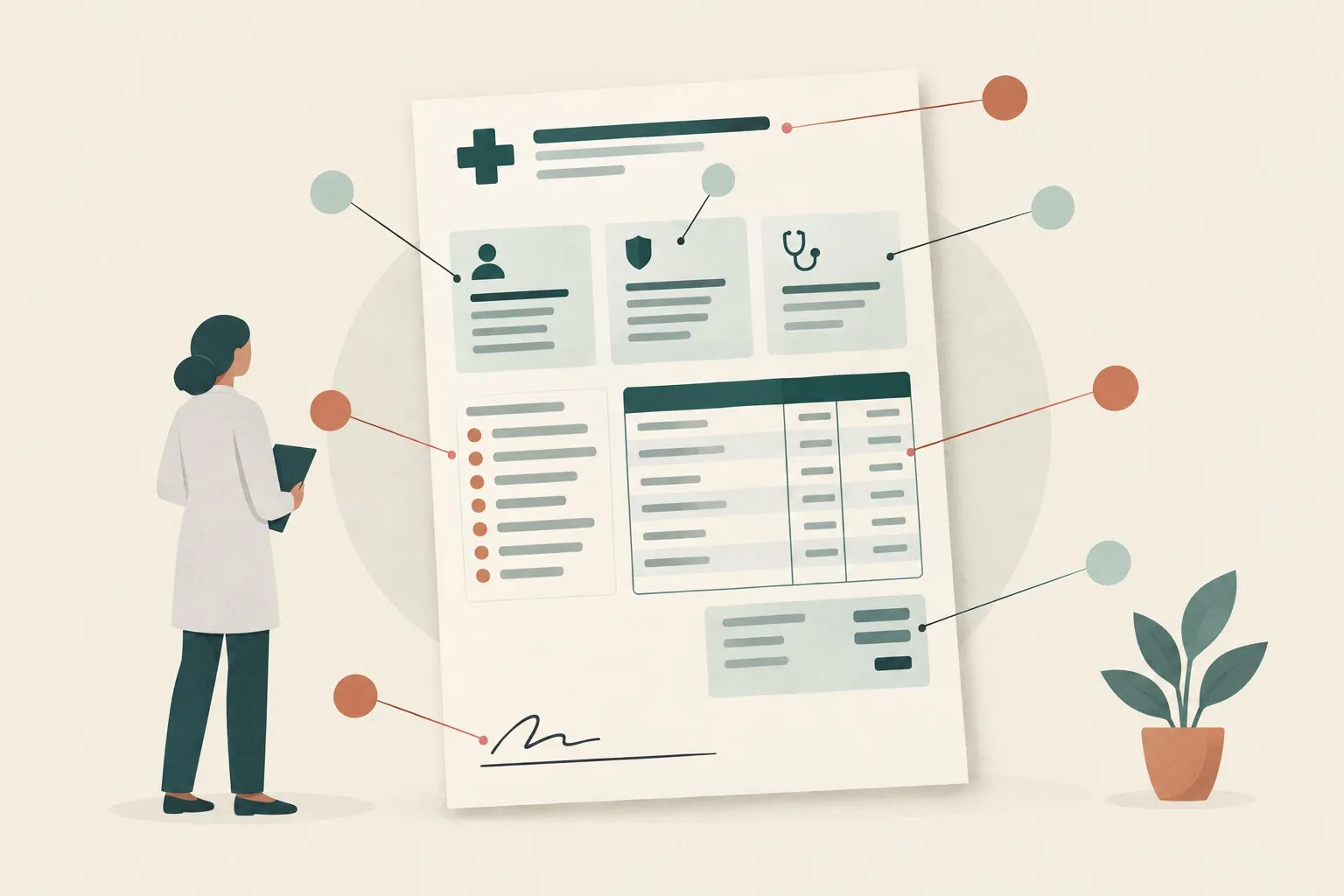
A superbill needs to include the provider’s name, credentials, address, NPI, and Tax ID; the patient’s name, date of birth, and insurance details; at least one ICD-10 diagnosis code; each service with its date, CPT code, place of service, diagnosis pointer, units, and fee; the amount paid; and the provider’s signature and date. Exact requirements vary by insurer, but leaving out any of these is a common reason out-of-network claims get delayed or returned.
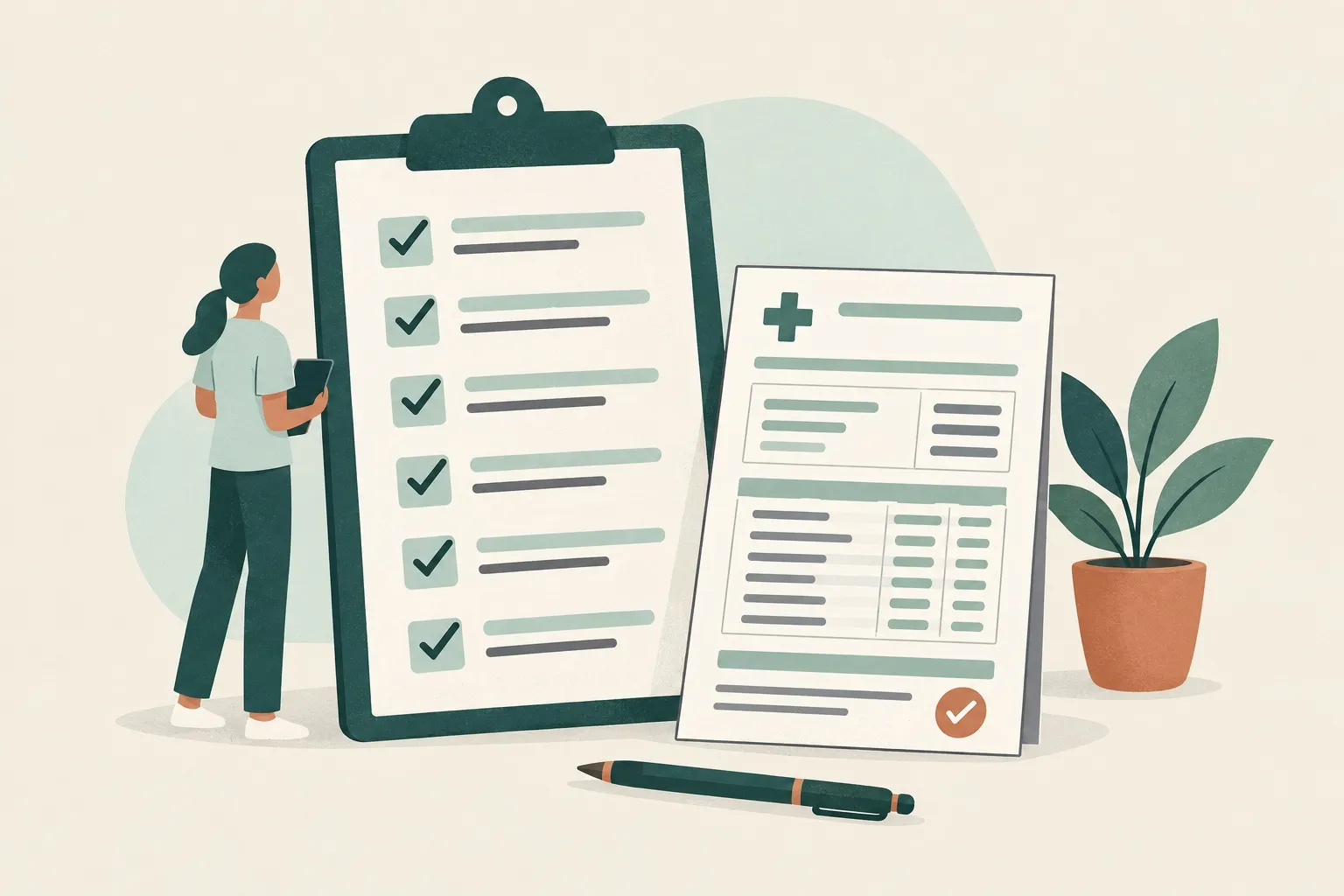
Use the checklist below whether you’re a provider creating superbills or a client checking one before you submit it. If you’re new to the concept, start with what a superbill is.
Superbill checklist at a glance
| Section | Field | Typically needed? |
|---|---|---|
| Provider | Provider name and credentials | Yes |
| Provider | Practice name and address | Yes |
| Provider | Phone number | Yes |
| Provider | NPI | Yes |
| Provider | Tax ID or EIN | Yes |
| Provider | License number | Often |
| Provider | Optional | |
| Patient | Full name | Yes |
| Patient | Date of birth | Yes |
| Patient | Address and phone | Often |
| Patient | Insurance carrier, member ID, group number | Yes |
| Diagnosis | ICD-10 code or codes | Yes |
| Services | Date of service | Yes |
| Services | CPT code, plus modifier when needed | Yes |
| Services | Place of service code | Yes |
| Services | Diagnosis pointer | Yes |
| Services | Units | Yes |
| Services | Fee | Yes |
| Payment | Total charges, amount paid, balance | Yes |
| Signature | Provider signature and date | Yes |
“Typically needed” reflects what insurers commonly ask for. A particular plan may want more, or accept less.

What provider information goes on a superbill?
Name, credentials, and practice address
Insurers use credentials to confirm that the provider type is covered under the plan. List the rendering provider’s name and credentials (for example, “Maya Chen, PsyD”), the practice name if there is one, and the address where services were provided. Add a phone number so the insurer can reach the practice with questions.
NPI (National Provider Identifier)
The NPI is a unique 10-digit number issued through the National Plan and Provider Enumeration System (NPPES). Two things to know:
- Type 1 vs. Type 2. Individual clinicians have a Type 1 NPI. Group practices and incorporated businesses may also have a Type 2 (organizational) NPI. A superbill should include at least the rendering provider’s Type 1 NPI; group practices often list both.
- Check digit. The last digit of every NPI is a check digit calculated from the first nine using the Luhn algorithm. Any single mistyped digit fails the check, and so do most swaps of two neighboring digits. That’s why NPI typos are such a common reason claims get returned. You can look up any NPI in the public NPPES NPI Registry.
Our generator validates the NPI check digit as you type, so a typo is flagged before you print.
Tax ID or EIN
The Tax ID identifies the business that received payment. Many solo clinicians get an Employer Identification Number (EIN) from the IRS rather than putting their Social Security number on documents clients handle. An EIN is nine digits, usually written like 12-3456789.
License number
Not every insurer requires it, but including your state license number answers a common follow-up question and helps when an insurer verifies credentials.
What patient information is required?
- Full name and date of birth, matching the insurance card exactly. A mismatch here is one of the most common, and most avoidable, reasons a claim stalls.
- Address and phone, which help the insurer match records.
- Insurance carrier, member ID, and group number, so the insurer can find the right policy.
If the patient is a dependent on someone else’s plan, the insurer’s claim form will ask for the policyholder’s information. The superbill itself describes the patient who received care.
How should diagnosis codes be listed?
Every superbill submitted to insurance needs at least one diagnosis code from the ICD-10-CM code set. Insurers use it to judge whether the service was medically necessary.
- Code to the highest specificity the clinical record supports. Many categories have more specific subcodes, and the category alone often isn’t billable. For example, F43.23 is a complete code, while F43.2 is a category that needs a further digit.
- Letter each diagnosis. The common convention, borrowed from the CMS-1500 claim form, is up to 12 diagnoses lettered A through L.
- Put the primary diagnosis first. List the main reason for the visit as A.
What details does each service line need?
Each service gets its own line. If a client had four sessions in a month, the superbill should show four lines, each with its own date.
Date of service
The date the service was provided. Avoid putting a date range on a single line for services that happened on separate days.
CPT code and modifier
The CPT code identifies what was done, for example 90837 for an hour-long psychotherapy session or 97110 for therapeutic exercise in physical therapy. Use the code that matches the service and, for time-based codes, the documented time. A modifier is a two-character add-on that gives the insurer more context, such as modifier 95, which some payers use for live audio-video telehealth.
Description
A short, plain description helps the client recognize the service. Write it in your own words; it doesn’t need to match the official code descriptor.
Place of service (POS)
The two-digit POS code tells the insurer where the service happened. Common ones on superbills:
| POS | Where the service took place |
|---|---|
| 11 | Office |
| 12 | Patient’s home, with the provider visiting |
| 02 | Telehealth, with the patient somewhere other than home |
| 10 | Telehealth, with the patient at home |
Telehealth coding varies by payer. Some insurers want POS 10 with modifier 95, some want POS 02, and some still ask for modifier GT or no modifier. See place of service codes for telehealth for details, and check the client’s plan when in doubt.
Diagnosis pointer
The pointer links each service to the diagnosis letter or letters it addresses, such as “A” or “A, B.” The CMS-1500 allows up to four pointers per service line, with the primary one first, and many superbills follow the same rule. A service that doesn’t point to any diagnosis gives the insurer no clinical reason to pay for it.
Units
Most psychotherapy codes are billed as one unit per session. Many physical, occupational, and speech therapy codes are timed and billed in multiple units, so a single visit might show two or three units of the same code. Our physical therapist superbill template includes common timed codes.
Fee
The charge for the line. When a line has more than one unit, make it clear whether the fee is per unit or a line total. In our generator, the fee is per unit and the line total is calculated for you.
Payment details
Show total charges, the amount the patient paid, and the remaining balance. Insurers reimburse patients for what they’ve actually paid, so a superbill that shows full payment and a zero balance makes the request clear. Adding the payment method or date in the notes can help too.
Signature and date
The provider’s signature and date attest that the services listed were provided. A typed signature is common on electronically produced superbills. If an insurer asks for a handwritten signature, print the superbill and sign it.
Common superbill mistakes that delay reimbursement
- A mistyped NPI. One wrong digit makes it invalid.
- No Tax ID. The NPI alone may not be enough.
- No diagnosis code, or service lines without diagnosis pointers.
- Incomplete ICD-10 codes, such as a category code that needs more digits.
- A patient name or date of birth that doesn’t match the insurance card.
- The wrong time-based code, such as an hour-long psychotherapy code for a shorter session.
- Telehealth coded differently from what the insurer requires.
- Several dates combined on one line instead of one line per date of service.
- A missing signature or date.
- Fees with no payment shown, leaving the insurer unsure what the patient paid.
Is there an official superbill format?
No. Unlike the CMS-1500, which is a standardized claim form, there’s no required superbill layout. A clean one-page PDF with clearly labeled sections works well. See a fully annotated superbill example, or read how a superbill differs from the CMS-1500 claim form.
How the generator helps you include everything
The free superbill generator has a built-in checklist that flags fields insurers usually require: provider name, practice address, a valid NPI, Tax ID, patient name and date of birth, a diagnosis code, a service with a date, CPT code, and fee, and a signature. When everything is filled in, it shows “Ready to print.” It also supports up to 12 lettered diagnoses, diagnosis pointers, modifiers, place of service, and units on every line, and the whole thing runs in your browser with nothing uploaded.
Create a complete superbill now — it’s free and stays in your browser.
FAQ
What information is required on a superbill?
Insurers generally expect the provider's name, address, NPI, and Tax ID; the patient's name, date of birth, and insurance member ID; at least one ICD-10 diagnosis code; and each service with its date, CPT code, place of service, and fee. A provider signature and the amount paid are also standard. Exact requirements vary by insurer.
Does a superbill need the provider's signature?
Most insurers expect the provider to sign and date the superbill, attesting that the services were provided. A typed signature is common on electronically produced superbills, but if an insurer asks for a handwritten one, print the superbill and sign it.
Do I need both an NPI and a Tax ID on a superbill?
Include both. The NPI identifies the provider, and the Tax ID or EIN identifies the business that was paid. Insurers commonly ask for both, and a missing identifier can delay processing.
How many diagnosis codes can a superbill have?
There is no universal limit for superbills, but the CMS-1500 claim form allows up to 12 diagnoses lettered A through L, and many superbills follow that convention. Each service line then points to the diagnoses it addresses.
Is there an official superbill format?
No. Unlike the CMS-1500 claim form, there is no standardized superbill layout. What matters is that the superbill contains the information the insurer needs and is easy to read.