A superbill example is easiest to understand section by section. Below is a complete sample superbill for psychotherapy from a fictional practice, Harbor Light Counseling, with notes on what each field is and why insurers look for it. Every name, number, and address in it is made up.
You can load this exact example into the free superbill generator with the Sample button, then edit it into your own.
What does a superbill look like?
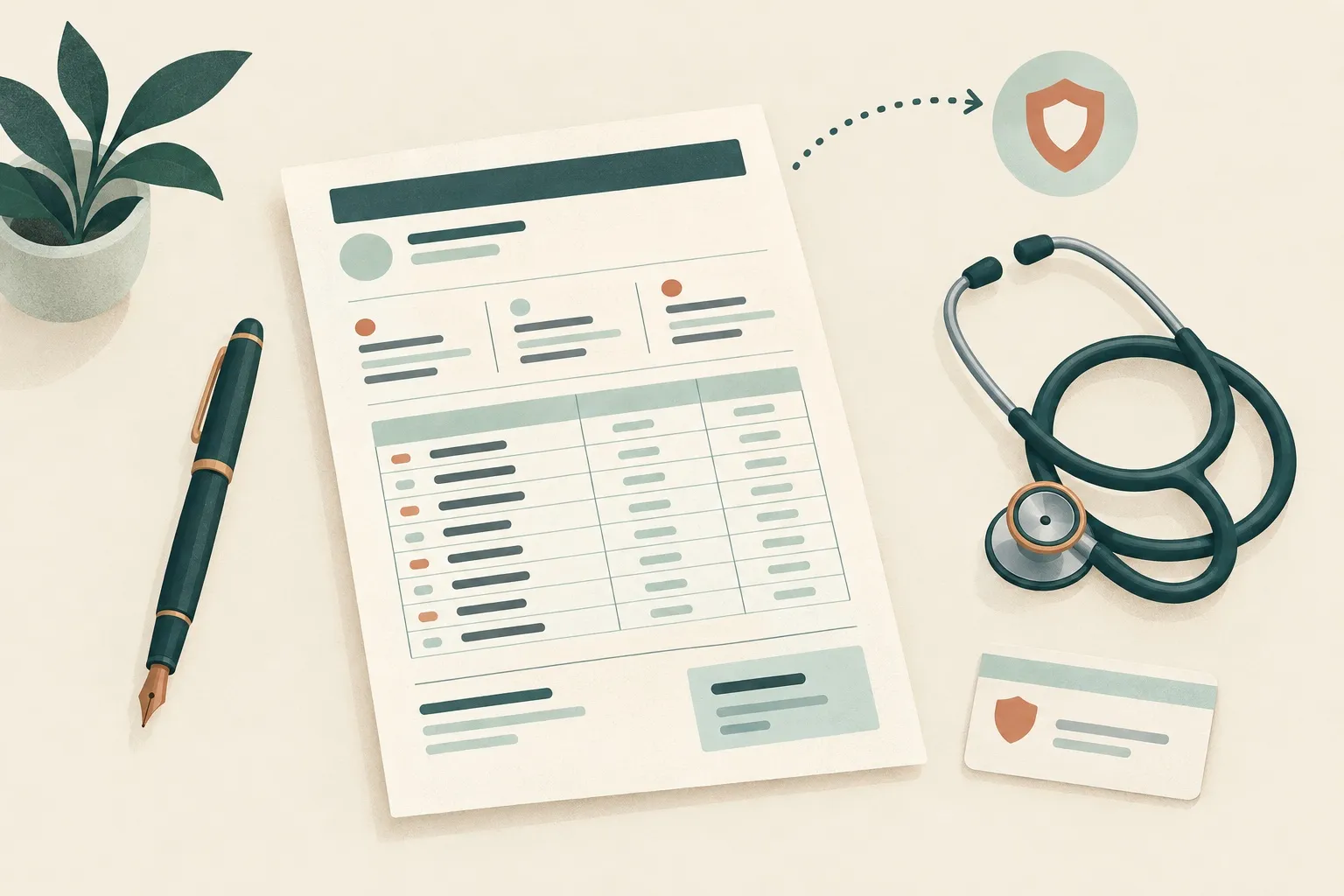
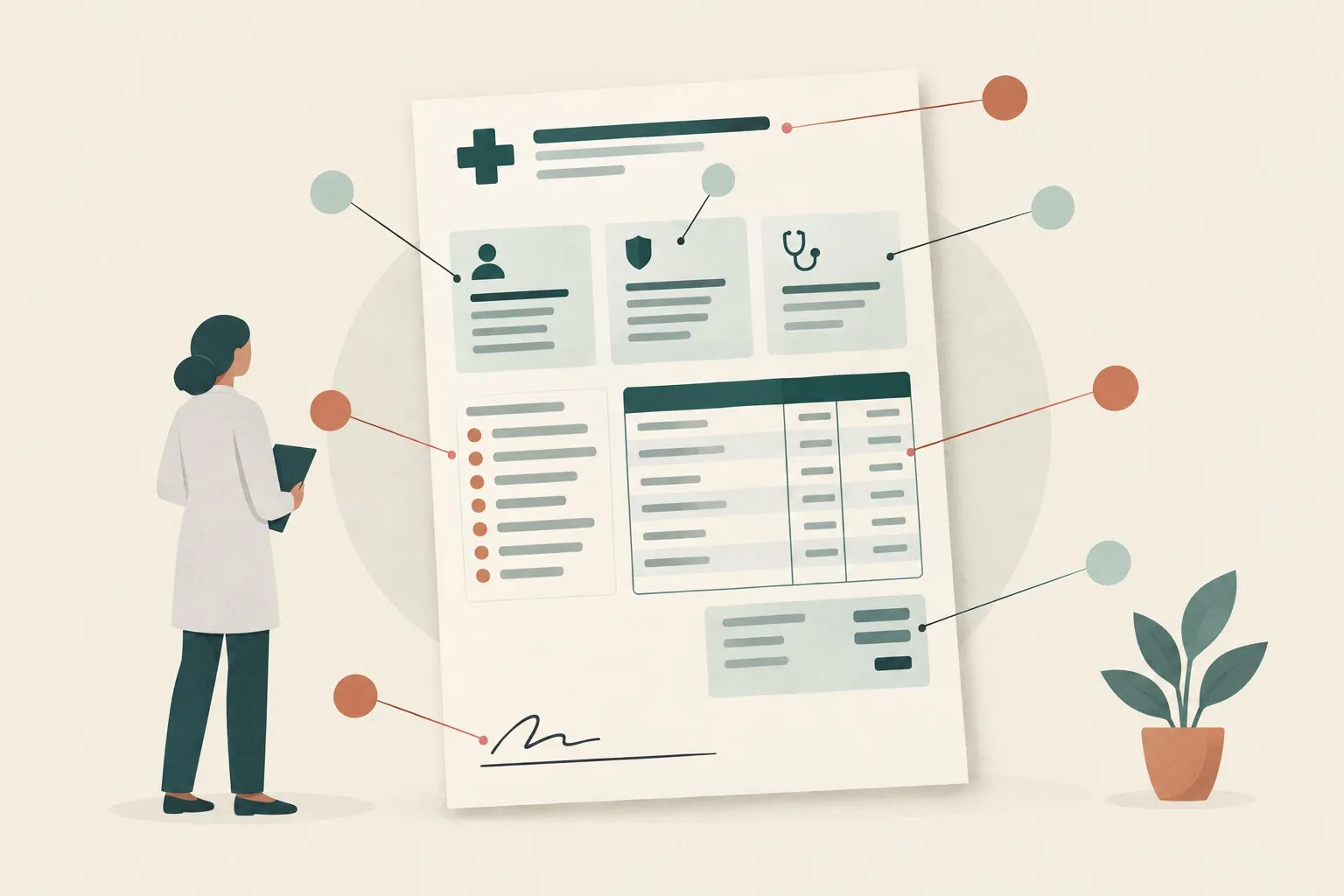
Most superbills fit on one page and follow the same structure:
- A header with the practice name, superbill number, and issue date
- Provider information
- Patient and insurance information
- Diagnosis codes (ICD-10)
- Service lines (dates, CPT codes, fees)
- Totals, payment, and balance
- Signature, date, and notes
There’s no single mandatory layout. What matters is that the insurer can quickly find each piece of information. Here’s how the sample handles each part.
The header
| Field | Sample value |
|---|---|
| Practice | Harbor Light Counseling |
| Superbill number | SB-1001 |
| Date issued | 11/05/2026 |
Insurers don’t require a superbill number, but it helps the practice and the client refer to a specific document if questions come up later, especially when superbills are issued monthly.
Provider information
| Field | Sample value | Why it’s there |
|---|---|---|
| Provider | Maya Chen, PsyD | Name and credentials show the provider type |
| Address | 1200 Market Street, Suite 410, San Francisco, CA 94102 | Where services were provided |
| Phone | (415) 555-0142 | Lets the insurer contact the practice |
| billing@harborlight.example | Optional, but handy for client questions | |
| NPI | 1234567893 | The provider’s 10-digit National Provider Identifier |
| Tax ID (EIN) | 12-3456789 | Identifies the business that was paid |
| License | PSY 12345 | Some insurers verify that the provider is licensed |
The NPI is the field most often mistyped. Every NPI has 10 digits, and the last one is a check digit calculated from the other nine, so a single wrong digit makes the number invalid. The generator validates the check digit as you type.
Patient and insurance information
| Field | Sample value |
|---|---|
| Patient | Jordan Rivera |
| Date of birth | 04/17/1990 |
| Address | 88 Alder Lane, Oakland, CA 94610 |
| Phone | (510) 555-0187 |
| Insurance carrier | Acme Health PPO |
| Member ID | XAC123456789 |
| Group number | 0045821 |
These fields let the insurer match the claim to the right member. The name and date of birth should match the insurance card exactly. If the client is covered as a dependent, the insurer’s claim form will also ask for the policyholder’s details.
Diagnosis codes
| Letter | ICD-10 code | Description |
|---|---|---|
| A | F41.1 | Generalized anxiety disorder |
| B | F43.23 | Adjustment disorder with mixed anxiety and depressed mood |
Diagnoses are lettered so each service line can point to the diagnosis it addresses. The generator supports up to 12 diagnoses lettered A through L, the same lettering used on the CMS-1500 claim form. In a real superbill, use the most specific ICD-10 code the clinical record supports.
Service lines
This is the core of the superbill. Each date of service gets its own line.
| Date | CPT | Mod | Description | POS | Dx pointer | Units | Fee |
|---|---|---|---|---|---|---|---|
| 10/15/2026 | 90791 | Diagnostic evaluation (intake) | 11 | A, B | 1 | $220.00 | |
| 10/22/2026 | 90837 | 95 | Psychotherapy, about 60 min | 10 | A | 1 | $180.00 |
| 10/29/2026 | 90837 | 95 | Psychotherapy, about 60 min | 10 | A | 1 | $180.00 |
| 11/05/2026 | 90837 | 95 | Psychotherapy, about 60 min | 10 | A | 1 | $180.00 |
The fees are fictional. Practices set their own, and insurers decide separately what they’ll allow.
Here’s what each column is doing:
- Date. The day the service was provided, not the day the superbill was written.
- CPT. The procedure code. The first visit is billed as CPT 90791, an initial diagnostic evaluation. The follow-up sessions use CPT 90837, individual psychotherapy of about an hour.
- Mod (modifier). A two-character code that adds detail. Here, modifier 95 flags the follow-up sessions as live audio-video telehealth.
- Description. A short plain-language label so the client recognizes each service. It doesn’t need to match the official code descriptor.
- POS (place of service). The intake took place in the office (POS 11). The follow-ups were telehealth with the client at home (POS 10). Telehealth coding varies by payer: some insurers want POS 10 or 02 with modifier 95, others want modifier GT or no modifier, so check the client’s plan. Our guide to place of service codes for telehealth explains the differences.
- Dx pointer. The intake addresses both diagnoses (A, B). The therapy sessions point to A.
- Units. Psychotherapy codes like these are billed as one unit per session. Timed codes common in physical and occupational therapy are often billed in several units per visit.
- Fee. The practice’s charge for the line. In the generator, the fee is per unit, and the line total is units multiplied by the fee.
Totals and payment
| Item | Amount |
|---|---|
| Total charges | $760.00 |
| Amount paid | $760.00 |
| Balance due | $0.00 |
The notes field reads “Paid by credit card at time of service.” Showing the amount paid and a zero balance tells the insurer the client has already paid and is asking to be reimbursed, and it lets the superbill double as a receipt. If the client still owed money, the balance line would show it.
Signature and notes
The sample is signed “Maya Chen, PsyD” and dated. The generator uses a typed signature, which is how many practices sign electronically produced superbills. If an insurer ever asks for a handwritten signature, print the PDF and sign it.
The notes field is a good place for the payment method, a reminder that the client is responsible for filing, or anything specific an insurer has asked for.
What the client does with this superbill
Jordan Rivera, the fictional client, would take this superbill and submit it to Acme Health PPO along with the insurer’s member claim form, usually through the member portal or app. The insurer would compare each line to Jordan’s out-of-network benefits, apply any remaining deductible and coinsurance, and send an explanation of benefits showing what it allowed and paid for each date of service. Because the superbill shows $760 paid and a zero balance, any reimbursement would normally go to Jordan rather than the practice.
How much comes back depends entirely on the plan. The insurer reimburses based on its own allowed amount for each code, not the fee on the superbill.
Mistakes to avoid when adapting a sample superbill
A sample is a great starting point, but it’s easy to leave something behind. Before you print your own version, check that you have:
- Replaced the sample NPI and Tax ID with your own. The sample NPI passes the check-digit test, so a validator won’t catch it if you forget.
- Updated every date of service. Each line should reflect a real session date.
- Matched the POS to where each session happened. In-person office sessions use POS 11 and no telehealth modifier.
- Chosen the code that fits the session length, for example 90834 instead of 90837 when a session was closer to 45 minutes.
- Checked every diagnosis pointer against the diagnosis letters you actually listed.
- Recalculated the totals. The amount paid and balance should reflect what the client actually paid.
- Signed and dated it with your own name and credentials.
What this superbill example doesn’t show
Superbills look different from one profession to the next. A few common variations:
- Physical, occupational, and speech therapy superbills often use timed codes billed in multiple units per visit.
- Chiropractic superbills typically combine manipulation codes with exam or therapy codes.
- Monthly superbills for weekly therapy clients often run four or five service lines, like the one above.
For a psychologist-specific starting point, use the psychologist superbill template, or browse all superbill templates by profession. For a field-by-field checklist, see what a superbill needs to include.
How to load this sample in the generator
- Open the generator on the home page.
- Click Sample above the preview. It fills in Harbor Light Counseling, Maya Chen, PsyD, and Jordan Rivera with these codes and fees, with service dates set relative to today.
- Edit any field. The preview updates live, and the checklist flags anything insurers usually require that’s missing.
- Click Print / Save PDF to print it or save a US Letter PDF.
Everything stays in your browser’s local storage. Nothing is uploaded. Prefer paper? Use Print blank template for a version you can fill in by hand.
Make your own superbill now — start from the sample or a blank page. It’s free and stays in your browser.
FAQ
What does a superbill look like?
A superbill is usually a one-page document with blocks for provider information, patient and insurance information, diagnosis codes, a table of service lines, payment totals, and the provider's signature. There is no single required layout, but insurers expect to find the same core details.
Can I use a sample superbill as a template?
Yes. Replace the sample practice, patient, codes, and fees with your own. In the free generator, the Sample button loads a fictional example you can edit, and your changes stay in your browser.
Why does the example use modifier 95 and POS 10?
In this example, the follow-up sessions were telehealth sessions with the client at home, which is what POS 10 indicates. Modifier 95 is one way payers ask providers to flag live audio-video telehealth, but requirements vary by insurer, so check what the client's plan expects.
Are the NPI and Tax ID in the example real?
No. The example uses 1234567893, a sample number that passes the NPI check-digit test, and the placeholder EIN 12-3456789. All names, addresses, and phone numbers are fictional.
Should a superbill show a zero balance?
If the client paid in full, yes. Showing the amount paid and a zero balance tells the insurer the client is seeking reimbursement for money already spent, and it lets the superbill double as a receipt.