
A superbill is an itemized receipt that a healthcare provider gives a patient, listing the services provided along with the details an insurance company needs: the provider’s NPI and Tax ID, the patient’s insurance information, ICD-10 diagnosis codes, CPT procedure codes, dates of service, and fees. Patients submit a superbill to their insurer to request reimbursement when they’ve paid a provider who is out of network or doesn’t bill insurance directly. It’s the documentation behind a claim, not a bill asking the patient to pay.
What does superbill mean?
The word comes from medical billing offices. For decades, practices used a preprinted “superbill” (also called an encounter form or charge slip) that listed the codes they used most often next to checkboxes. The clinician marked what was done during the visit, and the front desk used the form to bill the insurer.
Today, especially in private-pay practices, “superbill” usually means something more specific: a completed statement the provider hands the patient so the patient can file their own insurance claim. That’s the meaning this guide uses.
A useful way to think about it: a superbill is a receipt that speaks the insurer’s language. A plain receipt says “$180 paid on October 14.” A superbill says who provided the service and how to identify them, which diagnosis the service addressed, which procedure code describes it, where it happened, and what it cost.
What is a superbill for insurance?
Insurance companies process claims using standardized codes. When an in-network provider bills an insurer, the provider sends those codes directly, usually electronically. When a patient sees an out-of-network provider and pays up front, the insurer still needs the same coded information before it can decide what to reimburse. The superbill supplies it.
In practice, the patient sends the superbill along with the insurer’s member claim form (sometimes called a reimbursement form). The insurer reviews it against the patient’s out-of-network benefits and, if the service is covered, typically pays the patient rather than the provider.
Superbills in medical billing: who issues them?
The provider or the practice’s billing staff creates the superbill, because it contains clinical codes and provider identifiers the patient wouldn’t have. Superbills are especially common among clinicians who run private-pay or out-of-network practices, including:
- Therapists, counselors, psychologists, and psychiatrists
- Chiropractors, physical therapists, and occupational therapists
- Speech-language pathologists
- Acupuncturists, dietitians, and lactation consultants
- Podiatrists and optometrists
Each profession relies on a different set of codes. You can see common codes by specialty on our superbill templates page.

Who uses superbills?
Patients are the ones who put superbills to work. The most common situations:
- Out-of-network care. Your provider isn’t contracted with your insurance plan, but your plan has out-of-network benefits. You pay the provider, then file the superbill to get part of the cost back.
- Self-pay practices. Some providers don’t bill any insurance at all. A superbill lets their clients seek reimbursement on their own.
- HSA and FSA accounts. Account administrators often ask for itemized documentation of a medical expense. A superbill usually provides it. See using a superbill for HSA or FSA for details.
- Record keeping. Some patients keep superbills to track their health spending over the year.
What’s on a superbill?
Formats vary, but insurers generally look for the same core information. Missing items are one of the most common reasons out-of-network claims get delayed or sent back.
| Section | What it includes | Why it matters |
|---|---|---|
| Provider | Practice name, provider name and credentials, address, phone, NPI, Tax ID (EIN), license number | Identifies who provided the service and confirms a recognized provider type |
| Patient | Name, date of birth, address, insurance carrier, member ID, group number | Lets the insurer match the claim to the right member |
| Diagnoses | ICD-10 codes, usually lettered A, B, C, and so on | Shows why the service was medically necessary |
| Services | Date, CPT code, modifier, description, place of service, diagnosis pointer, units, fee | Describes exactly what was done, where, and what it cost |
| Payment | Total charges, amount paid, balance | Shows what the patient actually paid |
| Signature | Provider signature and date | Attests that the information is accurate |
For a field-by-field breakdown, read what a superbill needs to include. To see all of this on an actual page, look at our annotated superbill example.
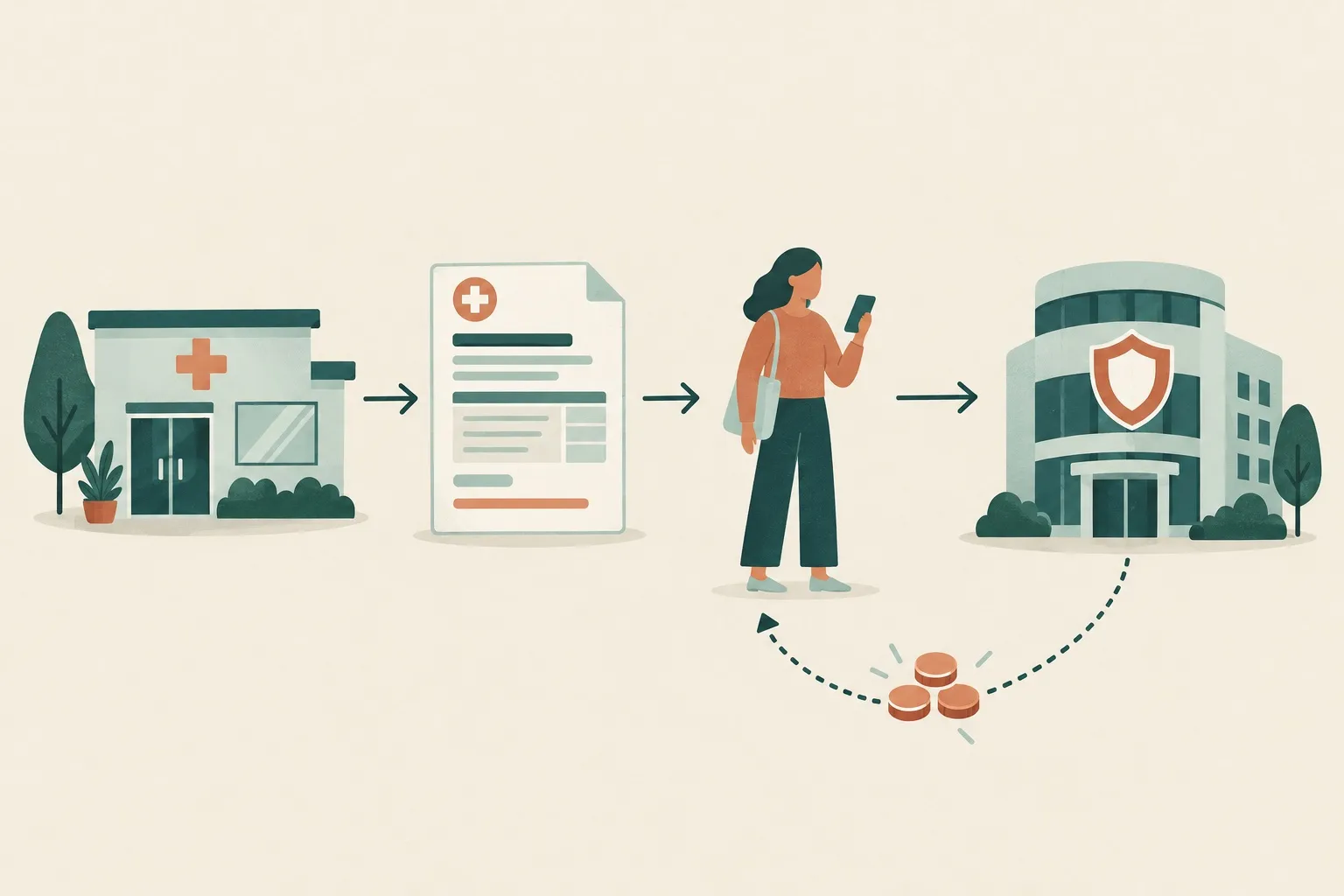
How do superbills work?
The process is straightforward once you’ve done it once. At a high level:
- You pay the provider. Private-pay and out-of-network providers typically collect their full fee at the time of service.
- The provider gives you a superbill. Some practices issue one after every visit. Many issue one per month that lists every session.
- You submit it to your insurer. Usually through the member portal, mobile app, mail, or fax, along with the insurer’s claim form.
- The insurer processes the claim. It checks your out-of-network deductible, your coinsurance, and plan rules such as visit limits or prior authorization.
- You receive an explanation of benefits (EOB) and payment. If the claim is approved, reimbursement is usually sent to you by check or direct deposit.
Our step-by-step guide on how to submit a superbill to insurance covers claim forms, deadlines, and denials in detail.
How much will insurance reimburse?
There’s no single answer. Out-of-network reimbursement depends on your plan’s deductible, your coinsurance percentage, and the insurer’s allowed amount for each service code. The allowed amount is the figure the plan treats as the covered price, and it isn’t necessarily what you paid. Insurers calculate allowed amounts in different ways, so two plans can reimburse very different amounts for the same visit.
The most reliable way to estimate is to call your insurer, give them the CPT code your provider uses, and ask what they would allow for it and what percentage they would pay after the deductible.
When and how often are superbills issued?
It depends on the practice. Some providers hand over a superbill at the end of every visit. Many, especially therapists seeing clients weekly, issue one superbill per month that lists each session on its own line. Others provide superbills only on request. If you plan to seek reimbursement, ask about the provider’s routine at your first appointment so you’re not waiting on paperwork near your plan’s filing deadline.
A single superbill can cover many visits, as long as each date of service is listed separately with its own code and fee.
Superbill vs. invoice vs. receipt vs. CMS-1500
These documents overlap, which is where much of the confusion comes from.
| Document | Who creates it | Purpose | Includes diagnosis and procedure codes? |
|---|---|---|---|
| Invoice | Provider | Requests payment from the patient | Usually not |
| Receipt | Provider | Confirms the patient paid | Usually not |
| Superbill | Provider | Gives the patient what they need to file an insurance claim | Yes |
| CMS-1500 | Provider or billing service | Standard claim form providers use to bill insurers directly | Yes |
A superbill can double as a receipt when it shows the amount paid and a zero balance. The CMS-1500 is a different kind of document: a standardized claim form, usually submitted by the provider to the insurer. Read superbill vs. CMS-1500 to see when each one is used.
Does a superbill guarantee reimbursement?
No. A superbill gives your insurer the information it needs, but whether you’re reimbursed depends on your plan. Common reasons a claim pays less than expected, or nothing at all:
- The plan has no out-of-network benefits (common with HMO and EPO plans)
- The out-of-network deductible hasn’t been met yet
- The service isn’t covered, or the insurer doesn’t consider it medically necessary
- The plan required prior authorization
- The claim was filed after the plan’s deadline
Checking your benefits before you start care, or at least before you submit, avoids most surprises. Requirements vary by insurer and by plan, so the plan documents and member services are the final word.
How providers can create superbills
You don’t need practice management software to make a professional superbill. Our free superbill generator runs entirely in your browser, and nothing is uploaded. Your practice details are saved in your browser’s local storage, so the next superbill starts half done. It includes:
- A live preview and Print / Save as PDF on US Letter paper
- NPI check-digit validation and a checklist that flags fields insurers usually require
- Up to 12 ICD-10 diagnoses, with a diagnosis pointer on each service line
- Profession templates preloaded with common codes
- CSV import from an EHR or spreadsheet export, including printing a superbill for every client at once
- A blank template you can print and fill in by hand
Create a superbill now — it’s free, there’s no account, and your data stays in your browser.
FAQ
Is a superbill the same as a receipt?
Not quite. A receipt shows that you paid. A superbill also includes the provider's NPI and Tax ID, your diagnosis codes, and a procedure code for each service, which is the information an insurer needs to process an out-of-network claim.
Who fills out a superbill, the patient or the provider?
The provider or their billing staff creates the superbill, because it contains clinical codes and provider identifiers. The patient then submits it to the insurance company, usually along with the insurer's own claim form.
Can I get reimbursed with a superbill if my provider is out of network?
Often, yes, if your plan includes out-of-network benefits. Your insurer applies your out-of-network deductible and coinsurance and reimburses based on its allowed amount, which may be less than what you paid. Plans without out-of-network coverage, such as many HMOs, usually will not reimburse.
Do providers charge for superbills?
Most private-pay practices provide superbills at no extra charge, but policies vary, so ask your provider. Providers can create superbills for free with an online superbill generator.
Does Medicare accept superbills?
Medicare generally works differently. Providers enrolled in Medicare usually must submit claims for covered services themselves, and providers who have opted out of Medicare use private contracts under which Medicare does not reimburse the patient. Superbills are mainly used with commercial insurance plans.